Few places on Earth pack as much geological luck, and as much complicated history, into one province as Katanga. Beneath its red laterite soil sits one of the richest copper-cobalt deposits ever discovered — a fact that has drawn empires, corporations and fortune-seekers here for more than 120 years, and that still defines daily life in Kolwezi today.
Before the mines: a known resource
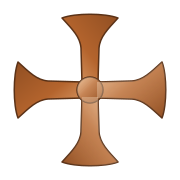
Copper working in this region predates colonialism by centuries. Local Katangese communities smelted copper into the famous X-shaped "handa" crosses used as currency and status objects across Central Africa long before European prospectors arrived. When Belgian-backed geologists began systematic surveys in the 1890s, they were mapping deposits local communities already knew intimately.
The Union Minière era (1906–1960s)
The Union Minière du Haut-Katanga, founded in 1906 under Belgian colonial concession, industrialised copper extraction at a scale the region had never seen. Company towns, railways and processing plants sprang up across Katanga, built substantially on forced and heavily exploitative colonial labour systems — a history our heritage guides discuss candidly on-site rather than skipping over.
"You cannot understand modern Kolwezi without understanding what was built here, and at what human cost, before independence."
By the 1950s, Union Minière was among the most productive copper operations in the world, and Katanga's mineral wealth had become central to Belgian colonial economic strategy — a fact that would shape the turbulent years immediately following Congolese independence in 1960.
Nationalisation and Gécamines
Following independence and the political upheaval of the Congo Crisis (during which Katanga briefly seceded under Moïse Tshombe), the Congolese state progressively nationalised the mining sector, culminating in the creation of Gécamines in 1967. For decades, Gécamines was one of the largest state mining companies in Africa — though production and infrastructure investment declined through the economic difficulties of the 1980s–90s.
The cobalt rush
Since the 2000s, and accelerating sharply over the last fifteen years, Kolwezi has become ground zero for a different kind of mining story: cobalt, a critical mineral for lithium-ion batteries used in phones, laptops and electric vehicles worldwide. The DRC now supplies the majority of the world's mined cobalt, and a large share of it comes from within a short drive of where you're reading this. Large-scale industrial operations now sit alongside a significant artisanal and small-scale mining sector — a complex reality that international supply chains, human rights organisations and the Congolese government continue to work through.
What you can see today
Our Historic Mine Heritage Tour walks you through this entire arc in a single day: preserved Union Minière-era headframes and colonial administrative buildings, decommissioned open-pit terraces where you can identify malachite and heterogenite ore by eye, and authorized viewpoints over the scale of today's active mega-mines. It's rare to be able to physically stand in more than a century of industrial history in one afternoon — and rarer still to have it explained by guides who've often worked the industry themselves.